
How to find a Matching Donor Drives?
Hard disk donor drive guidelines are designed to help you maximize compatibility when searching for a donor head stack assembly. While a perfect match cannot be guaranteed, following these steps will increase your chances of success.
Begin by identifying the make of the hard drive and matching the specifications provided. Note that this guide does not cover quantum drives or older Western digital models (pre-Caviar). For reference, we’ve highlighted where to find the relevant details on the label in the sample images provided. Keep in mind that your label may vary based on the product line or manufacturing date.
Each specification is prioritized and color-coded to indicate its importance. While finding a donor that matches all the criteria might not be possible, the color-coding will help you focus on the most critical details. more details, contact us
RED: Essential. You almost certainly cannot use a donor without this matching.
ORANGE: high priority. This information is often required to match for a donor to be compatible.
YELLOW: Medium priority. This information can help increase the chances of compatibility if a match is available.
GREEN: Low priority. This is normally not a factor but can be used to choose between multiple donors matching everything else.
Toshiba
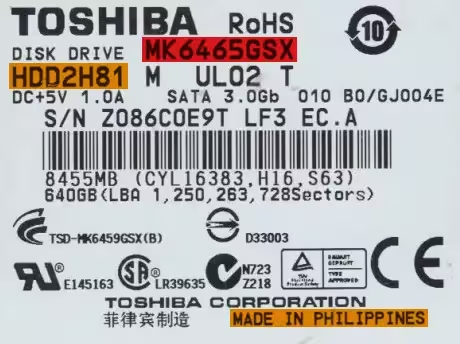
Use the following criteria to find a donor drive.
Model number: Match the whole number. If you cannot do this, you may be able to match the first eight digits of the model number and the family code instead.
Country of manufacture: Should be the same.
Hard drive code: The first part of the HDD code should match.
Hitachi
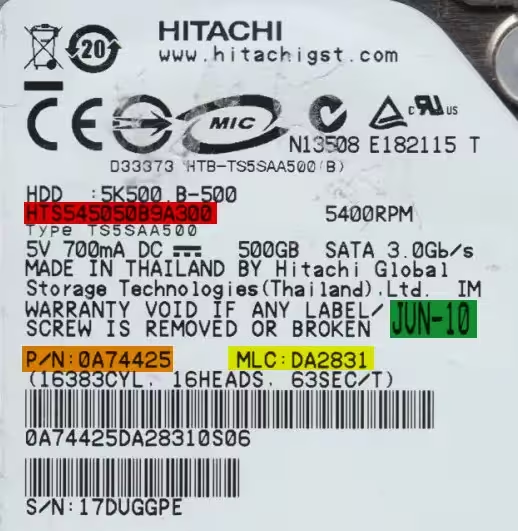
Use the following criteria to find a donor drive.
Model number: Match the model number exactly.
Part number: Match the part number exactly.
Heads map: Match the physical heads (PH) map exactly. It is OK if the donor has more heads than the original drive, but all heads before that should match.
MLC: Match the MLC exactly.
Date of manufacture: Should be within three months — the closer the better.
Older
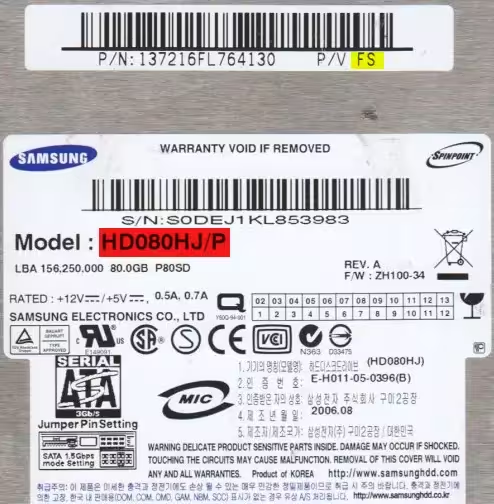
These drives can be identified by having a separate barcode sticker with two sets of numbers on it.
Use the following criteria to find a donor drive.
Model number: Match the model number exactly.
Heads map: Match the physical heads (PH) map exactly. It is OK if the donor has more heads than the original drive, but all heads before that should match.
Country of manufacture: Should be the same.
P/V: To the right of the part number. Some drives may be missing this field.
PCB revision: PCB Rev should be the same.
Newer
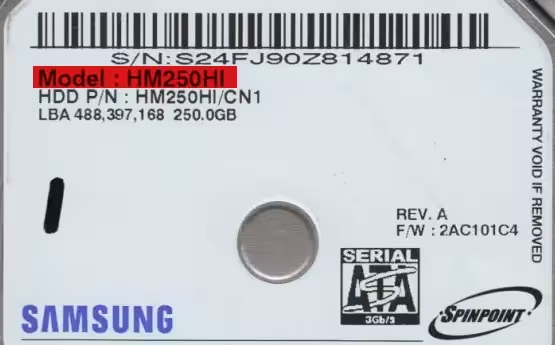
These are 2.5″ inch drives, series M7S2, M7E (i.e. Mercury / Rev .07 / S3M), MP4, MT2, M8E, and M9T, as well as 3.5″ inch drives, series F3 or later. The series can be found printed on the PCB or in some instances on the drive label.
Use the following criteria to find a donor drive.
Model number: Match the model number exactly.
Heads map: Match the physical heads (PH) map exactly. It is OK if the donor has more heads than the original drive, but all heads before that should match.
Preamplifier revision: The preamplifier revision should be the same.
Barracuda
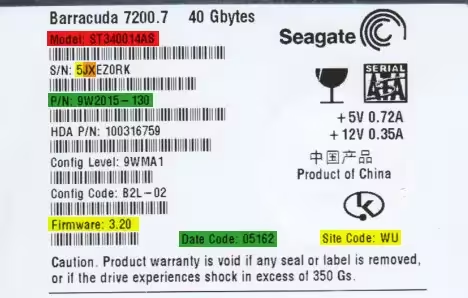
These drives can be identified by containing a period (.) in the firmware number.
Use the following criteria to find a donor drive.
Model number: Match the model number exactly.
Heads map: Match the physical heads (PH) map exactly. It is OK if the donor has more heads than the original drive, but all heads before that should match.
Serial number: Match the second and third characters of the serial number.
Firmware (7-series or earlier): Optional — For drives that are 7-series or earlier, match the firmware number.
Serial number: In addition to the 2nd and 3rd digit, match the first character of the serial number.
Site code: Match the site code. This indicates the location of manufacture.
Part number: Match the 1st half of the part number. If the second half also matches, it is likely to be an even better match.
Date code: Convert the date codes. They should be within three months of each other — the closer the better.
F3
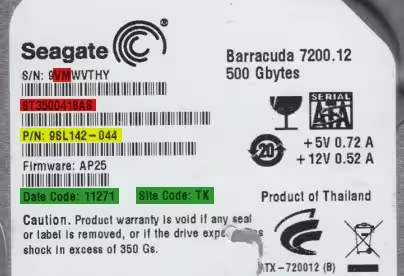
These drives can be identified by NOT containing a period ( . ) in the firmware number.
Use the following criteria to find a donor drive.
Model number: Match the model number exactly.
Serial number: Match the second and third characters of the serial number.
Heads map: Match the physical heads (PH) map exactly. It is OK if the donor has more heads than the original drive, but all heads before that should match.
Preamplifier type: Optional — Match the first two digits of the preamplifier type.
Part number: Match the 1st half of the part number. If the second half also matches, it is likely to be an even better match.
Site code: Match the site code. This indicates the location of manufacture.
Date code: Convert the date codes. They should be within three months of each other — the closer the better.
Caviar 1st Edition
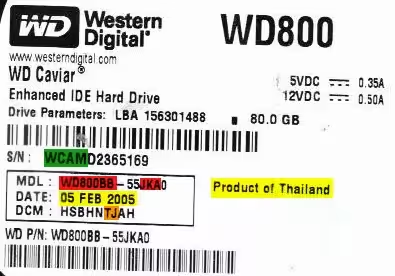
These are generally drives that are 10 or more years old. They can be differentiated by having a PCB that is, more or less, square compared to the L-shaped PCBs of later models.
Use the following criteria to find a donor drive.
Model number: Match the entire first part of the model number as well as three characters in the second part. Eg: WD800BB-55JKA0
Heads map: Match the physical heads (PH) map exactly. It is OK if the donor has more heads than the original drive, but all heads before that should match.
DCM: Locate the J or 2 in the DCM. It should be towards the end. Make sure that the J or 2 as well as the preceding character matches on the donor.
Country of manufacture: Should be the same.
Date of manufacture: Should be within three months — the closer the better.
Serial number: Match the first four digits of the serial numbers.
PCB Revision: The PCB Rev should be the same.
Marvell (version 1)
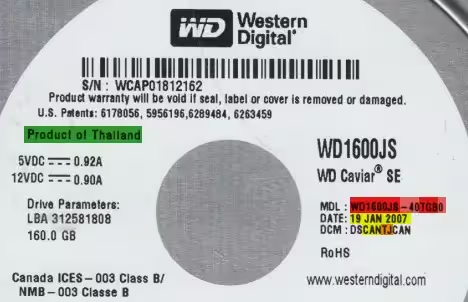
These drives can be identified by the family code in the model number (the 3rd and 4th digits after the hyphen). The following families are part of this type: Mammoth (family codes EY, EZ, FA, FC, FJ, FM, HE, HF, JE, JS, JT, JY), Sabre (JH, JJ, JK, JL, JM, JN, JP, JR, JU, KS, LN, MG), Hawk (MH, MJ, MK, ML, MV, MW, MY, MZ, NC, ND, NE, NF, NG, NH, NJ, NK, NT, NV, NY, PA), Hawk-2 (SG, SH, TG), Starling (RD, RE, RF, RJ, RK, RL), Buccaneer (KE, KF, KG, KM), Zeus (MN, MP, VJ), and Raider (PC, PD, PE, PF, PG). Even if these families of drives say “Caviar SE” on the label, they belong to the Marvell architecture.
Use the following criteria to find a donor drive.
Model number: It is ideal to match the whole model number, but if none is available you can try one that matches the entire first part of the model number as well as these three characters in the second part: WD1600JB-40TGB0
Heads map: Match the physical heads (PH) map exactly. It is OK if the donor has more heads than the original drive, but all heads before that should match.
DCM: Locate the J or 2 in the DCM. It should be towards the end. Make sure that the J or 2 as well as the preceding character matches on the donor. If the three characters before that match as well, it will have an even better chance of being a match.
Date of manufacture: Should be within three months — the closer the better.
Preamplifier: Exact match for both vendor and revision.
Microjogs: Each value should be within 300 of the original drive — the closer the better.
Country of manufacture: Should be the same.
Marvell (version 2)
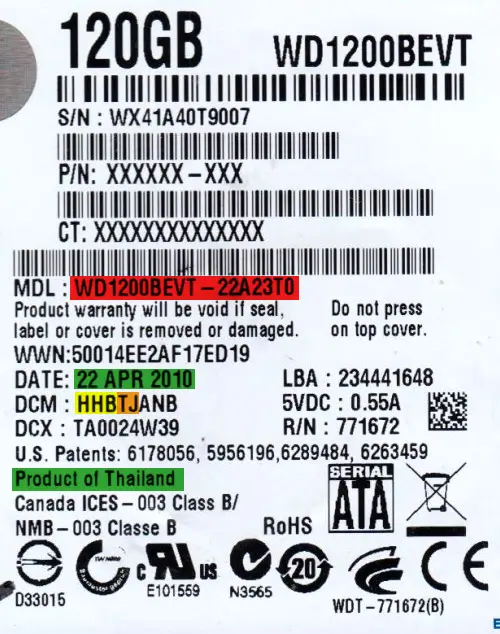
These encompass most newer and modern Western Digital drives.
Use the following criteria to find a donor drive.
Model number: It is ideal to match the whole model number, but if none is available you can try one that matches the entire first part of the model number as well as these three characters in the second part: WD1200BEVT-22A23T0
Heads map: Match the physical heads (PH) map exactly. It is OK if the donor has more heads than the original drive, but all heads before that should match.
DCM: Locate the J or 2 in the DCM. It should be towards the end. Make sure that the J or 2 as well as the preceding character matches on the donor.
Preamplifier: Exact match for both vendor and revision.
Microjogs: Each value should be within 200 of the original drive — the closer the better.
Country of manufacture: Should be the same.
Date of manufacture: Should be within three months — the closer the better.
RAID rebuild failure can occur for several reasons, and understanding these causes is important for preventing permanent data loss in business servers and storage environments. A RAID rebuild is the process of restoring data redundancy after replacing a failed drive in a RAID array. While RAID systems are designed for reliability, rebuild operations place heavy stress on all drives, increasing the risk of additional failures.
One of the most common causes of RAID rebuild failure is the presence of bad sectors on remaining drives. During the rebuild process, the RAID controller must read every sector across the array. If another disk contains unreadable sectors or hidden corruption, the rebuild may stop completely or produce corrupted data.
A second major cause is multiple disk failure. In RAID levels such as RAID 5, only one drive failure can typically be tolerated. If another drive fails during rebuilding, the entire array may become inaccessible. Older drives are especially vulnerable because the rebuild process puts continuous load on aging hardware components.
Incorrect RAID configuration is another frequent issue. Wrong stripe size, disk order, parity rotation, or controller settings can prevent successful rebuilding. This often happens after controller replacement, firmware updates, or accidental RAID reconfiguration. Even small configuration mismatches can cause severe data corruption.
Power interruptions during rebuilding can also damage the RAID structure. Unexpected shutdowns may interrupt parity synchronization and leave the array in an inconsistent state. Businesses using RAID servers should always use UPS power backup systems to minimize this risk.
Firmware incompatibility between drives and RAID controllers can contribute to rebuild failures as well. Drives from different manufacturers or mismatched firmware versions may behave differently under rebuild conditions, causing instability within the array.
Human error is another important factor. Accidentally replacing the wrong disk, forcing rebuild operations incorrectly, or initializing the array instead of rebuilding it can permanently overwrite critical metadata. In many cases, DIY RAID rebuild attempts worsen the situation and reduce recovery chances.
Overheating and insufficient cooling can also trigger rebuild failure. RAID rebuilds generate significant disk activity, increasing internal drive temperatures. Poor airflow inside server environments may cause additional drive failures during the process.
Professional RAID recovery specialists often recommend creating a sector-by-sector backup image before attempting any rebuild. This protects the original data and allows safe reconstruction using specialized RAID recovery tools.
To reduce rebuild failure risks, businesses should monitor drive health regularly, replace failing disks early, maintain verified backups, and use enterprise-grade storage hardware. Preventive maintenance plays a critical role in RAID reliability.
In conclusion, RAID rebuild failure is commonly caused by bad sectors, multiple disk failures, incorrect configurations, power interruptions, firmware conflicts, and human mistakes. Proper maintenance, monitoring, and professional recovery support can help protect critical business data and improve RAID recovery success rates.
Yes, professional data recovery services can recover data from both NAS and SAN storage systems. These advanced storage technologies are widely used by businesses, enterprises, and organizations to store large volumes of critical data, including databases, virtual machines, backups, multimedia files, and shared network resources.
NAS, or Network Attached Storage, is a centralized file storage system connected through a network. It allows multiple users and devices to access files simultaneously. SAN, or Storage Area Network, is a high-speed storage architecture designed for enterprise environments that require fast and reliable data access across servers and applications.
Data loss in NAS and SAN systems can occur for many reasons. Common causes include RAID failure, multiple disk crashes, controller malfunction, firmware corruption, accidental deletion, ransomware attacks, power surges, and file system corruption. Because these systems often rely on complex RAID configurations, recovering data requires advanced technical expertise.
Professional NAS recovery services support leading brands such as Synology, QNAP, NetApp, Dell Technologies, and HPE. Recovery experts can rebuild damaged RAID arrays, repair corrupted file systems, and recover inaccessible shared folders from these devices.
SAN recovery is typically more complex because SAN environments may involve Fibre Channel connections, multiple storage nodes, virtualization platforms, and enterprise-grade RAID systems. Recovering data from SAN infrastructure often requires detailed analysis of storage architecture, RAID parameters, and logical volume configurations.
One important advantage of professional NAS and SAN recovery services is the use of non-destructive recovery techniques. Technicians create complete disk images before starting reconstruction to prevent additional damage to the original storage environment. Specialized software tools are then used to rebuild RAID structures virtually and recover files safely.
Recovery success depends on factors such as the severity of the damage, the number of failed disks, and whether the storage system has been modified after failure. Immediate shutdown of the affected system is usually recommended to avoid overwriting critical metadata.
Businesses should avoid attempting DIY recovery on enterprise storage systems because incorrect rebuilding procedures can permanently destroy valuable data. Professional labs use advanced forensic tools and cleanroom facilities when physical disk repairs are necessary.
In addition to recovery, many providers also assist with backup strategy planning, disaster recovery preparation, and RAID health monitoring to reduce future risks.
In conclusion, NAS and SAN storage systems can often be recovered successfully by experienced data recovery professionals. Whether the issue involves RAID corruption, hardware failure, or accidental deletion, specialized recovery methods can help restore important business data securely and efficiently.
Yes, damaged RAID arrays can often be rebuilt safely, but the process must be handled carefully to avoid permanent data loss. RAID systems are designed to improve storage reliability and performance, but when multiple disks fail or RAID metadata becomes corrupted, rebuilding the array incorrectly can destroy valuable information.
A safe RAID rebuild begins with identifying the exact cause of the failure. Common issues include failed hard drives, corrupted RAID configurations, damaged controllers, bad sectors, firmware problems, or accidental reconfiguration. Before any rebuilding starts, professional technicians usually perform a complete diagnostic analysis of the RAID environment.
One of the safest practices in RAID recovery is creating sector-by-sector images of all drives before making changes to the array. This preserves the original data and allows recovery specialists to work on cloned copies instead of the actual disks. If mistakes occur during rebuilding, the original drives remain untouched.
Professional RAID recovery experts use advanced software tools to analyze RAID parameters such as stripe size, disk sequence, parity rotation, block order, and file system structure. Even a small configuration error can make recovered data unusable, which is why accurate RAID reconstruction is critical.
Damaged RAID arrays should never be rebuilt automatically without understanding the root problem. For example, if a drive has hidden bad sectors or silent corruption, forcing a rebuild may place excessive stress on remaining disks and trigger additional failures. In RAID 5 systems, this is especially dangerous because only one drive failure is typically tolerated.
Businesses often make the mistake of replacing the wrong disk or initializing the array accidentally. These actions can overwrite RAID metadata and complicate recovery significantly. In enterprise environments, even experienced IT teams may require specialized RAID recovery assistance for complex failures.
RAID rebuild safety also depends on the condition of the storage hardware. Drives producing clicking sounds, overheating, or read errors may require cleanroom repair before rebuilding can proceed safely. Attempting rebuilds on physically unstable drives increases the risk of total data loss.
Professional recovery labs often use virtual RAID reconstruction methods. Instead of modifying the original array directly, they simulate the RAID structure in software and extract recoverable data from the virtual environment. This greatly reduces the risk associated with rebuilding damaged arrays.
To improve RAID reliability, organizations should maintain regular backups, monitor SMART drive health, replace failing disks proactively, and use uninterrupted power supplies. Preventive maintenance reduces the likelihood of catastrophic RAID failures.
In conclusion, damaged RAID arrays can be rebuilt safely when handled by experienced professionals using non-destructive recovery methods. Careful diagnostics, disk imaging, virtual reconstruction, and proper RAID analysis are essential for protecting valuable business data during the recovery process.
Yes, data can often be successfully recovered from a failed hard disk, even when the drive becomes inaccessible, corrupted, damaged, or completely unreadable. Professional hard disk data recovery services use advanced tools and recovery techniques to retrieve lost files from failed HDDs caused by accidental deletion, formatting, virus attacks, bad sectors, firmware corruption, electrical damage, and mechanical failure. In many cases, valuable data such as photos, videos, office documents, databases, emails, software files, and business records can still be restored safely.
Hard disk failures are usually categorized into two main types: logical failure and physical failure. Logical hard disk failure occurs when the hard drive hardware is functioning properly, but the stored data becomes inaccessible because of software-related problems. Common examples include corrupted partitions, damaged file systems, accidental formatting, deleted files, operating system crashes, and malware infections. In such situations, professional data recovery specialists use advanced recovery software and forensic-level tools to scan the hard drive and recover lost files without damaging the original data.
Physical hard disk failure is more serious and happens when internal hardware components stop working correctly. Signs of physical hard drive damage include clicking sounds, grinding noises, overheating, slow performance, spinning failure, or the hard drive not being detected by the computer. Physical damage can occur because of power surges, accidental drops, water exposure, fire damage, head crashes, motor failure, or PCB damage. Recovering data from a physically damaged hard drive often requires specialized cleanroom environments where engineers can safely open the drive and repair damaged components temporarily to access the stored information.
The chances of successful hard disk data recovery depend on several important factors, including the severity of the damage, the condition of the storage platters, and how quickly professional recovery is attempted. If the hard drive starts showing warning signs such as unusual noises, frequent system crashes, disappearing files, or detection errors, it is important to stop using the drive immediately. Continuing to operate a failing hard disk can overwrite recoverable data or cause additional internal damage, reducing the recovery success rate significantly.
Professional hard drive recovery services support almost all major hard disk brands including Seagate, Western Digital, Toshiba, Samsung, and Hitachi. Recovery solutions are available for desktop hard drives, laptop HDDs, external hard disks, RAID servers, NAS devices, and enterprise storage systems. Many recovery labs also provide emergency data recovery services for businesses and individuals who need urgent access to critical files.
To avoid future data loss, experts strongly recommend maintaining regular backups using external storage devices, cloud backup solutions, or automated backup systems. Although hard disk failure can happen unexpectedly, professional data recovery services can often recover important files successfully when proper recovery procedures are followed. Seeking immediate assistance from experienced recovery specialists greatly improves the possibility of restoring lost data from a failed hard disk safely and efficiently.
SSD data recovery is generally more difficult than traditional HDD recovery because solid-state drives use advanced storage technologies that handle data very differently from mechanical hard drives. While SSDs are faster, quieter, and more reliable for daily performance, recovering lost data from a failed SSD can be significantly more complex due to features like TRIM commands, wear leveling, firmware management, encryption, and integrated controllers. These technologies improve SSD performance and lifespan, but they also make professional data recovery more challenging.
Traditional hard disk drives (HDDs) store data magnetically on spinning platters. Even after files are deleted, the original data often remains physically stored on the disk until it is overwritten by new information. This makes HDD data recovery relatively easier because professional recovery tools can scan the storage sectors and restore deleted or lost files successfully in many cases.
In contrast, solid-state drives store data electronically using NAND flash memory chips instead of spinning disks. Most SSDs use a feature called TRIM, which automatically erases deleted data blocks to improve speed and optimize storage performance. Once the TRIM command is executed, the deleted files may be permanently removed from the SSD, making recovery extremely difficult or sometimes impossible. This is one of the biggest reasons why SSD data recovery has a lower success rate compared to HDD recovery in certain situations.
Another major challenge is wear leveling technology. SSDs constantly move data between memory cells to distribute write operations evenly and extend the lifespan of the drive. Because data is frequently relocated internally, file structures become more complicated and difficult to reconstruct during the recovery process. Unlike HDDs where data locations remain relatively fixed, SSDs dynamically manage storage allocation using complex algorithms controlled by the SSD firmware.
Firmware corruption is another common issue in failed SSDs. The firmware controls how the SSD communicates with the computer and manages stored data. If the firmware becomes corrupted due to power failure, electrical damage, overheating, or manufacturing defects, the SSD may suddenly stop being detected. Recovering data from firmware-damaged SSDs often requires advanced chip-level recovery techniques and specialized hardware tools used only by professional SSD recovery laboratories.
Modern SSDs also commonly include built-in encryption and security protocols. Even if the memory chips are physically intact, encrypted data may be inaccessible without the correct controller information or encryption keys. This adds another layer of complexity to SSD data recovery procedures.
Professional SSD data recovery services support leading brands including Samsung, Kingston, Crucial, SanDisk, Western Digital, and Intel. Recovery experts use advanced forensic tools, chip-off recovery methods, and controller-level diagnostics to recover files from failed SSDs whenever possible.
If an SSD begins showing symptoms such as slow performance, file corruption, read/write errors, or detection failure, it is important to stop using the drive immediately. Continuing to use a failing SSD may trigger further TRIM operations or memory degradation, reducing the chances of successful data recovery. Seeking professional SSD data recovery services quickly provides the best opportunity to recover important files safely and efficiently.
If your USB drive is showing the error message “Device Not Recognized,” it usually means your computer cannot properly detect or communicate with the USB storage device. This is a common problem that can occur with USB flash drives, external hard drives, memory cards, and portable storage devices. The issue may be caused by hardware failure, corrupted drivers, damaged file systems, firmware problems, or physical damage to the USB drive itself. In many cases, professional USB data recovery services can still recover important files from an unrecognized USB drive successfully.
One of the most common causes of the “USB Device Not Recognized” error is file system corruption. Improper ejection of the USB drive, sudden power loss, interrupted file transfers, or virus infections can damage the file system structure, making the device unreadable by the operating system. When this happens, the computer may fail to assign a drive letter or prompt users to format the device before use. Formatting should be avoided if important files are stored on the USB drive because it can reduce the chances of successful data recovery.
Another frequent reason is damaged or outdated USB drivers. Windows or other operating systems rely on USB controller drivers to communicate with connected storage devices. If the drivers become corrupted, outdated, or incompatible after system updates, the USB drive may stop being recognized properly. Reinstalling or updating USB drivers can sometimes resolve the issue without data loss.
Physical damage is also a major cause of USB recognition problems. USB drives are small and portable, making them vulnerable to accidental drops, bent connectors, water damage, overheating, dust exposure, and electrical surges. A damaged USB connector or broken internal circuit board may prevent the computer from detecting the device entirely. In severe cases, professional chip-level USB data recovery techniques may be required to extract the stored data directly from the memory chip.
Virus and malware infections can also trigger USB detection errors. Malicious software may corrupt partitions, hide files, damage boot sectors, or block access to the storage device. Running infected USB drives on multiple systems without proper antivirus protection increases the risk of file corruption and permanent data loss.
Sometimes the issue may originate from insufficient power supply through USB ports. External hard drives and some high-capacity USB devices require stable power to function correctly. Faulty USB ports, damaged cables, or power fluctuations can interrupt communication between the device and the computer. Trying a different USB port or another computer can help determine whether the problem is related to the device or the system itself.
Professional USB data recovery services support most major storage brands including SanDisk, Kingston, Samsung, Transcend, and HP. IBM Recovery experts use specialized diagnostic tools and forensic recovery methods to restore inaccessible files from corrupted or physically damaged USB drives.
If your USB drive displays the “Device Not Recognized” error, stop using the device immediately to avoid overwriting or further damaging the data. Avoid repeated formatting attempts or unreliable DIY recovery tools, especially if the files are valuable. Seeking professional USB drive recovery assistance quickly improves the chances of safely recovering important documents, photos, videos, and business data from the failed storage device.